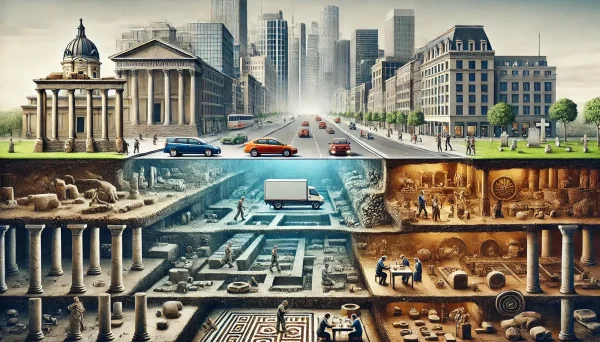
When we think of archaeology, we often imagine remote deserts, ancient ruins in jungles, or sunken ships beneath the sea. But some of the most astonishing archaeological discoveries have occurred right beneath the feet of modern city dwellers. As urban centers expand, renovate, or dig new subway lines, unexpected windows into the past emerge—revealing buried temples, forgotten cemeteries, ancient roads, and entire neighborhoods lost to time. These findings not only reshape our understanding of history but also remind us that every city has deep roots hidden below its surface.
1. The Aztec Temple in Mexico City
In 2017, construction workers in the heart of Mexico City uncovered a circular platform linked to the Aztec god of wind, Ehecatl. Beneath a colonial-era building, archaeologists found the remains of an ancient temple and ball court. Mexico City was built atop the ruins of Tenochtitlán, the Aztec capital, and new discoveries continue to surface. This particular find revealed how the Spanish conquest quite literally layered a new city over the sacred spaces of an older one.
2. Roman Streets Under London
London is one of the world’s richest archaeological cities, thanks to its long and layered history. In 2013, while building a new office tower in the financial district, workers unearthed over 10,000 Roman-era artifacts—including wooden tablets with ancient handwriting, shoes, tools, and personal items. The discovery of an entire Roman street, dubbed the “Pompeii of the North,” offered a rare glimpse into daily life in Londinium nearly 2,000 years ago.
3. The City of Akhetaten Under Cairo
Beneath the modern city of Cairo lie traces of earlier Egyptian settlements. One of the most significant discoveries occurred not far from the capital: the ancient city of Akhetaten, built by Pharaoh Akhenaten. While most of it lies in the open area of Amarna, portions have been detected beneath modern developments through satellite imaging and limited excavations. These findings suggest that Egypt’s spiritual and political shifts under Akhenaten may have left physical footprints closer to today’s cities than previously thought.
4. The Colosseum’s Underground Expansion – Rome
Rome is a city where every excavation has the potential to reveal history. Recent work around the Colosseum and nearby metro lines has brought new discoveries to light—like previously unknown underground chambers, animal cages, and drainage systems used for naval battles staged in the arena. These additions continue to reshape our understanding of how this ancient entertainment hub functioned.
5. Viking Artifacts in Dublin
Underneath Dublin’s medieval streets lies a much older Viking past. In the 1970s and 1980s, large-scale excavations in the Temple Bar and Wood Quay areas revealed well-preserved Viking houses, jewelry, and even wooden boardwalks. As Dublin modernized, archaeologists worked to save as much as possible before new buildings covered these sites. The discoveries confirmed that the city was once a thriving Norse settlement known as Dyflin.
6. Byzantine Mosaics in Istanbul
Istanbul, formerly Constantinople, is built atop layers of Greek, Roman, and Ottoman civilizations. In 2018, during restoration work in the Fatih district, archaeologists uncovered vivid Byzantine mosaics that had been buried for centuries. These floors, likely part of a wealthy residence or religious building, revealed intricate geometric designs and Christian symbols—remnants of the city’s early Christian era.
7. Subterranean Temples in Naples
Naples is famous for its underground world, including Roman aqueducts, Greek roads, and early Christian burial sites. In recent decades, parts of an ancient Greco-Roman theater were uncovered directly beneath apartment buildings in the city’s historic center. One entrance to the ruins is literally through someone’s basement—highlighting how closely past and present coexist in this chaotic, ancient metropolis.
8. Ancient Chinese Tombs in Xi’an
Xi’an is best known as the home of the Terracotta Army, but construction projects across the city constantly reveal more buried wonders. As high-rise developments expand, archaeologists have discovered Tang Dynasty tombs filled with murals, ceramics, and treasures. These finds offer new insights into Chinese burial customs, art, and daily life during one of the country’s most vibrant dynastic periods.
9. Greek Agora in Thessaloniki
In the early 2000s, while building a new metro line in Thessaloniki, Greece, workers encountered an ancient Roman forum with marble-paved streets, shops, and even drainage systems. Excavation revealed a layered history stretching back to Hellenistic and Byzantine times. Rather than remove the artifacts, the city redesigned parts of the metro stations to include museum-like displays—blending transit and history in daily life.
10. Medieval Cemeteries Under Paris
While the Catacombs of Paris are famous, more recent discoveries have shed light on the medieval population buried beneath the city. During renovations of the Monoprix supermarket in 2015, a mass burial site was found beneath the building, dating back to the 14th century. The remains were likely victims of the Black Death. Their discovery provided vital information about medieval health, death, and burial practices in one of Europe’s most historic cities.
Conclusion: Layers Beneath the Pavement
Modern cities are built atop countless layers of human history. Each new building, tunnel, or subway station has the potential to unlock lost chapters of civilization. These discoveries remind us that the past is never far away—that beneath the concrete, glass, and steel of today’s cities lie secrets waiting to be told. Archaeology in urban settings not only connects us to ancient cultures but also reshapes how we see the cities we live in every day.